1.1 – 1st child of Samuel Anderson and Margaret Dunbar
Ann ANDERSON Michael CARBERRY
b. 20th April 1826 b. 1804/5
at Inverness, Scotland at Tyrone, Ireland
d. 10th June 1906 d. July 1855
at Kiama, NSW at Kiama, NSW
Those,of course, who are best acquainted with the world, or have read most extensively the histories of men, will probably allow that in the formation of character, the most telling influence is the early home. One night ask “What is it makes a home? ” and we would all answer “A mother’s love.”
Ann was baptised at Croy and Dalcross on the 29th May 1826. She was aged 12 when she travelled with her family to Australia. Ann and Michael Carberry were married in 1842. They were to have a family of four children before Michael’s death in 1855.
Michael arrived on the ship “Asia” as did Ann and her family. Asia made a number voyages to the colonies, and the one on which Ann and her family arrived was the only voyage which wasn’t a convict voyage. So accordingly, Michael was a convict who arrived on Asia in 1832 under Master Stead. His trade was listed as weaver and soldier, from Tyrone, and his offence was stealing wine. After his Court Martial in Gibraltar on the 11th December 1830, Michael was sentenced to 7 years, his Prisoner’s Number being 32/393. He later received his Ticket-Of-Leave on the 19th April 1836, although under a recommendation made in November 1835 he was permitted to remain in the district of Patricks Plains. On his Certificate of Freedom, dated 11th May 1838, Michael’s complexion is described as ruddy, 5 feet 7 inches tall, dark brown hair, mixed with grey, grey eyes, and with partially missing eyebrows. Michael’s brother Francis, also a weaver and soldier from Tyrone, was sentenced to seven years also, at the same court-martial as Michael, on the same date. He was born the year before Michael, and his description was listed as being 5’7 ¾ “ tall, with a ruddy and pock pitted complexion, brown hair mixed with grey and grey eyes.
Michael was buried on the 7th July 1855 at the Roman Catholic Cemetery at Kiama, NSW. At the time of his death his occupation was listed as a farmer, although on two of his children’s baptism certificates he is listed as a settler and a labourer. Ann and Michael’s last child, their daughter Mary, was born several months after her fathers death. A note attached to Mary’s baptism stated that, “Mrs Carberry’s husband died a few months previous to the birth of this child.” Ann & Michael’s family were as follows:
1.1.1 Elizabeth (Betsie) CARBERRY b. 7th November 1844 at Jamberoo, NSW
1.1.2 Margaret (Maggie) CARBERRY b. 3rd February 1847 at Jamberoo, NSW
1.1.3 Francis CARBERRY b. 10th June 1850 at Jamberoo, NSW
1.1.4 Catherine CARBERRY b. 1853 at Kiama, NSW
1.1.5 Mary CARBERRY b. 23rd September 1855 at Jerrara, NSW.
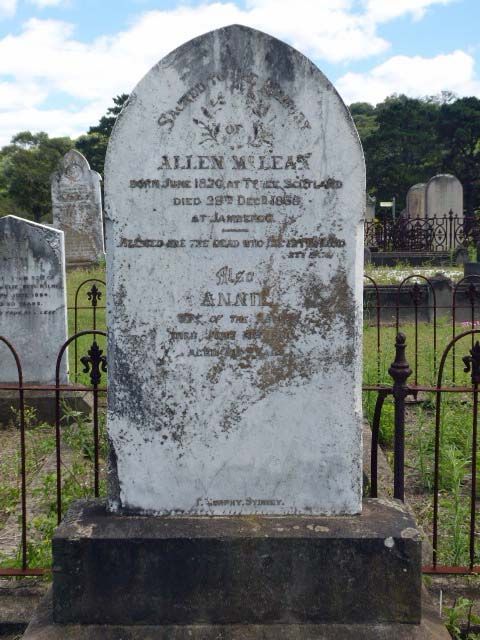
On the 9th March 1857 (Reg: 1915) at Kiama, NSW, Ann Carberry (nee Anderson) remarried to Allan McLEAN. Allan was the son of John & Jessie McLEAN. He had been born on the Island of Tyree, Argyle, Scotland, and was baptised on the 13th June 1820. Allan & Ann were to have six children, bringing the total of Ann’s children to 11, before Allan’s death on the 29th December 1888 at Jamberoo, NSW. The Kiama General Cemetery Record stated that he had been born in June 1820, at Tyree, Scotland. The children of Ann’s marriage to Allen McLEAN were as follows:
1.1.6 Jessie McLEAN b. 1858 (reg: 8010)
1.1.7 Ann McLEAN b. 1860 (reg: 7762)
1.1.8 John Allan McLEAN b. Aug 1862 (reg: 8557)
1.1.9 Esther (Ettie) McLEAN b. 1863 (reg: 8640)
1.1.10 Flora McLEAN b. 1866 (reg: 9572)
1.1.11 Lillian McLEAN b. 1869 (reg: 12348)
Obituary
Mrs Allan McLean
Obituary – Mrs Allen McLean
Kiama Independent, and Shoalhaven Advertiser (NSW : 1863 – 1947), Tuesday 19 June 1906, page 2
MRS. ALLAN McLEAN. Among the numerous families who were forced, as it were, to leave their native heaths-owing to bad land laws-to seek out homes, if not fortunes, in a then almost unknown country during the late thirties and early forties was one which emigrated from the Parish of Croy, Invernesshire, Scotland, to Australia in the year 1839. This family was Donald Anderson, together with his wife and a family, comprising Ann, John, Samuel, Margaret and Mary. Mr. Donald Anderson remained in Sydney about twelve months, where Margaret died, and shortly afterwards Kate was born, Mr. Anderson then decided to come to Illawarra, and to due course landed at Wollongong. Shortly after their arrival in Wollongong, this family, in common with hundreds of other families in those primitive days of advancement, found themselves perched on a bullock waggon surrounded with a load of general merchandise en route for Jamberoo. The first night of this dreary journey was spent at John Terry-Hughes’ station on the banks of the Macquarie Rivulet (now known as Albion Park). The next day the journey was resumed, and concluded, which in all human probability was, hailed with delight by every member of the family, as it is said no pen could describe, nor the keenest imagination conceive the emigrants feel-ings of those days, with nothing to see on either side of the lonely track but dense bush or gigantic forest of trees, and no idea of any monetary future in front. At that time there was no sign of a house or a home between John Terry. -Hughes’ station and Captain Hart’s brewery at Woodstack, Jamberoo. No, nothing but chained gangs of humanity, being driven like brute beasts to and from their wretched hovels to make roads, by men far more coarser than those in the chain.
Those of us who can remember some-thing of the later, pioneering days know fall well that luxuries or refinements had no monopolies. Everyone seemed to settle down to the stern realities of bush life and bush habits. Many, of course, retained as much of the home customs and habits as was compatible with their surroundings, whilst others drifted away into all sorts of conditions; the few remained steadfast, working to a future, thus showing how difficult it is to drum the aboriginal nature out of some people, let visionaries say what they may.
Among the emblems of Celtic nationality not one is more cherished by the Scottish race than their homes, therefore, Mr. Ander son soon found a home on Mr. Jolhn Ritchie’s estate adjoining the Cole proper ties of to-day. Here the subject of my sketch, the late Mrs. Allan McLean was married to the late Michael Carberry, by whom she had five children, of whom, only two are living. Betsey married Mr. John ston Graham, both being dead; Maggie married Mr. John Young, she is dead; Kate married Mr. Hector McKinton, she is dead; leaving Mrs. Wallace (of New. Zeal and) and Mr. Frank Carberry (of Jerrara) the only surviviig, members of that very much respected pioneer family. Later on the lately deceased lady married the late Mr. Allan McLean, by whom she had 6 children, Jessie married the late Mr. Wil liam Charmers, he is since dead; Annie married Mr. William Hutt, she has since died; Ettie married Mr. James Walker, he is dead ; Florrie married. Mr. Lees, she is dead; leaving behind Mrs. Charmers, Mrs. Walker, Mrs. Morris, and Mr. John McLean the only survivors of the second marriage. Mr. Allan McLean died about 16 years ago. The only surviv ing member of the Anderson family is Mr. John Anderson, of Sydney.
In or about the year 1842 the late Mr. Donald Anderson and Mr. Michael Carberry, purchased adjoining farms on the banks of the Jerrara Creek, and passed through all the hardships and troubles of pioneering. The pioneering, however, in those days seemed to make the inhabitants of the bush more generous, more sympathetic, than they appear to be now-a-days. Those,of course, who are best acquainted with the world, or have read most extensively the histories of men, will probably allow that in the formation of character, the most telling influence is the early home. One night ask “What is it makes a home? ” and we would all answer “A mother’s love.”
In this cruel, cold world a tender mother’s love and a religious mother’s care make the home, and mingles in every picture of pre-eminent happiness. . Mrs. Allan McLean was such a mother, and did much good by her example of self-denial to show what can be done by a mother for her family, Her life was never a bed of roses yet she always endeavored to wear a smile when a neighbor dropped in to see her. She had many troubles. The busy reaper Death knocked at her door with painful regularity, sweeping off, one after another of those whom she had nursed with a true mother’s love and care At last in came her own turn to obey the command, and she peacefully passed away. Although she was in her 81st year, she would give one the impression few years back, owing to the tender nursing she had received from her daughters, that she would have seen at least ten more summers. She met, however, with an accident some months since, causing a fracture of her thigh. Old and all as she was then, she since got up and could walk about, but the shock to her system was too severe, and she gradually sunk under the strain. Perhaps if her own feelings were consulted she would say in the words of the poet- a “Worlds should not bribe to back to tread Again life’s dreary waste, To see the future overspread With all the gloomy past.”
Those of us who knew her best liked her most, as she was naturally of a very retiring disposition, never caring to mix with anyone beyond the limits of her own sphere of life. She h s now passed over to a more peaceful world, and one can say in conclusion that Mrs. Allan McLean was a good wife, a good mother and a good kind neighbor. She, therefore, did her duty, inasmuch as she tried to make this country better than she found it in 1839 F. M’C.
1906 ‘MRS. ALLAN M’LEAN.’, The Kiama Independent, and Shoalhaven Advertiser (NSW : 1863 – 1947), 19 June, p. 2. , http://nla.gov.au/nla.news-article103176366
 Anderson Family Reunion